Introduction
Pop the hood on a loader, tractor, or Class 8 truck and you'll find two metal cores mounted almost side by side. One is the radiator. One is the AC condenser. Most operators can't tell them apart, and that's a problem.
Here's why it matters: mistaking one for the other leads to the wrong parts order, a second shipping delay, and equipment sitting idle longer than it should.
A machine that's overheating doesn't need an AC condenser. A cab with no cold air doesn't need a new radiator. Confuse the two, and you've wasted money and downtime chasing the wrong fix.
Roughly 20% of commercial-vehicle parts fall into a category that's genuinely hard to source quickly, according to a 2022 FleetOwner report on parts sourcing. Ordering the wrong component just adds to that delay.
This guide breaks down what each part actually does, how to tell them apart, warning signs of failure, and where to find replacement parts fast.
Key Takeaways
- A radiator cools engine coolant; an AC condenser cools refrigerant — separate loops, shared airflow.
- Both mount close together at the front of the equipment, but they fail independently and show different symptoms.
- Debris buildup and impact damage often hit both components at once, so inspect them together.
- Replacement costs vary widely by equipment type, manufacturer, and OEM vs. aftermarket choice.
- Sourcing correct-fit parts across multiple heavy equipment brands is easier with a dedicated cooling systems supplier.
Radiator vs. AC Condenser: Understanding the Basics
Both parts are heat exchangers. Both rely on airflow moving across metal fins to reject heat. That's where the similarity ends.
A radiator handles the engine's coolant loop. An AC condenser handles the refrigerant loop that keeps the cab cool. The two systems never share fluid or connect to each other; they just happen to sit in the same crowded space at the front of the machine.
What Does a Radiator Do?
Engine coolant absorbs heat as it circulates through the block and cylinder head. That hot coolant then flows into the radiator, where it passes through a network of tubes and fins. Air moving across the fins pulls the heat away and coolant returns to the engine at a lower temperature, ready to absorb more heat.
Heavy equipment engines generate more heat than passenger vehicles for a few specific reasons:
- Sustained full-load operation, especially in construction, mining, and agricultural duty cycles
- EGR systems and modern high-output diesel engines, which increase overall cooling demand
- Enclosure restriction on gen-sets and equipment with limited airflow around the radiator
- High ambient temperatures and altitude, which reduce cooling efficiency
Equipment manufacturers treat the radiator, hoses, thermostat, and airflow devices as one interconnected system rather than isolated parts. A weak link anywhere in that chain raises operating temperature.
What Does an AC Condenser Do?
The AC condenser is part of the refrigerant circuit, not the coolant circuit. Here's the cycle: the compressor pulls in low-pressure refrigerant vapor and compresses it into high-pressure, high-temperature vapor.
That hot vapor enters the condenser, where outside air pulls the heat out. As it cools, the refrigerant changes state from gas to high-pressure liquid, which then moves on to the receiver-drier and expansion valve before reaching the evaporator, according to Red Dot's heavy-duty HVAC service manual.
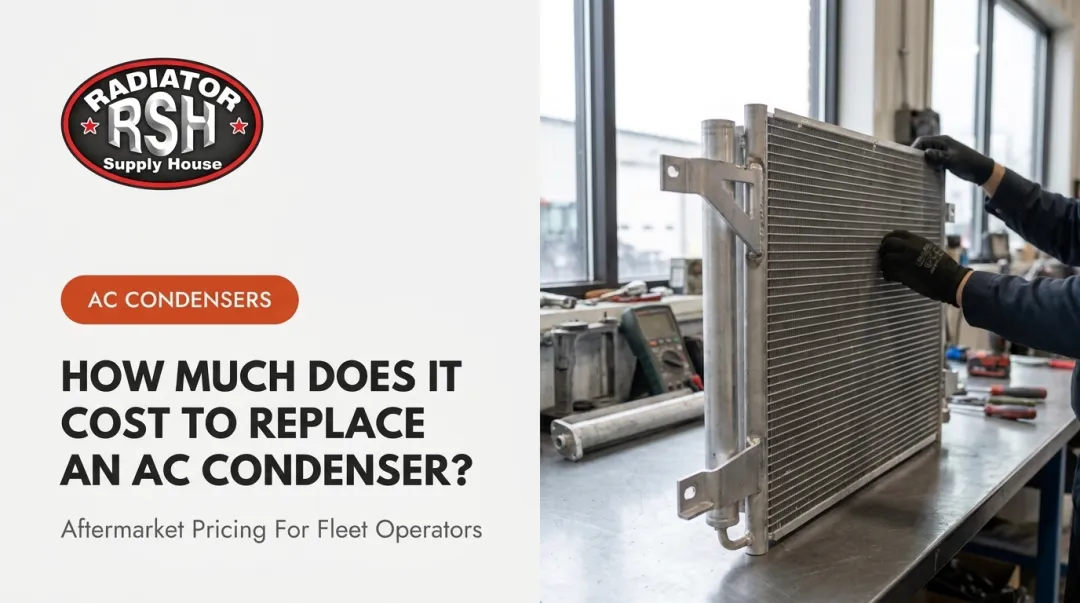
Condensers typically mount in front of the radiator to catch the coolest available air first. Depending on the equipment, you'll find:
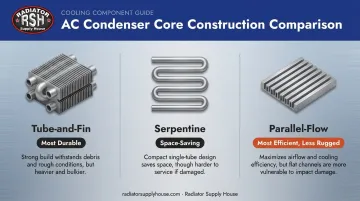
- Tube-and-fin designs: the strongest construction, common where durability matters more than compactness
- Serpentine cores: a single flat multi-pass tube, good heat rejection in tight spaces
- Parallel-flow cores: the most thermally efficient, but less rugged under vibration and impact
Key Differences Between a Radiator and an AC Condenser
Side by side, these components look similar. Functionally, they're not related at all.
Function. The radiator manages engine coolant temperature, while the condenser manages refrigerant state change for the AC system. They never share fluid or connect directly, not even through a shared reservoir.
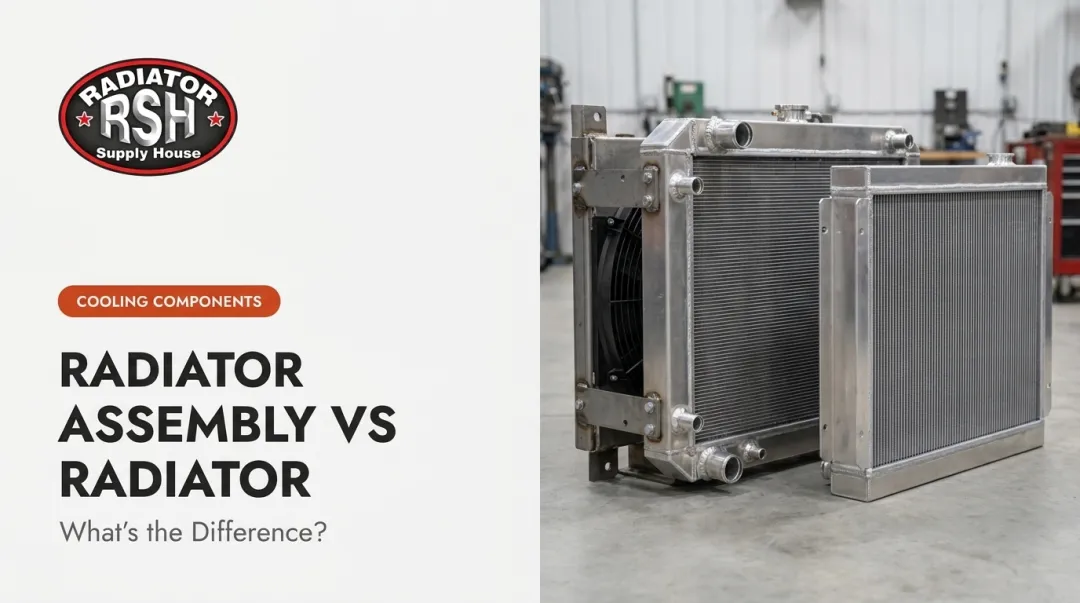
Construction and materials. Radiators for heavy equipment show up in both copper-brass and all-aluminum builds, depending on the application. Even within the same equipment line, one model might use an all-aluminum core while another sticks with copper-brass.
AC condensers, by contrast, are almost universally all-aluminum across the industry. Lighter weight matters more here, since condensers mount furthest forward and take the brunt of road debris.
Position and airflow priority. Condensers sit in front of radiators because refrigerant needs the coolest air available to condense efficiently. Radiators get "second pass" air, which is usually still cool enough for coolant temperature control.
Do radiators have condensers built in? No. They're separate, adjacent components, not one integrated unit. Some equipment uses combined cooling packages, but based on current product data, those packages typically pair a radiator with an oil cooler, not a radiator with a condenser. AC condensers are sold and installed as standalone parts.
Consequence of failure. This is the distinction that matters most in the field:
| Dimension | Radiator | AC Condenser |
|---|---|---|
| Fluid type | Engine coolant | Refrigerant |
| Primary job | Reject engine heat | Reject AC heat, condense vapor to liquid |
| Typical mounting | Behind the condenser | In front of the radiator |
| Failure impact | Engine overheating, potential shutdown | Loss of cabin cooling only |
| Engine temperature affected? | Yes | No |
If the temperature gauge climbs, look at the radiator. If the cab won't cool but the engine runs fine, look at the condenser.
Signs of a Failing Radiator or AC Condenser
Both parts show distinct warning signs. Knowing which symptom points to which system saves a diagnostic headache.
Radiator Failure Symptoms
Techs servicing Caterpillar and other heavy equipment commonly watch for these radiator failure indicators:
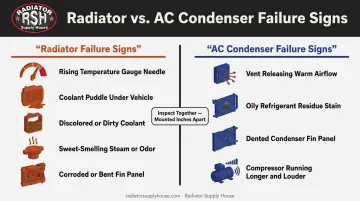
- Rising temperature gauge or overheating during normal operation
- Visible coolant leaks or puddles under the machine
- Discolored, low, or contaminated coolant
- Sweet odor or steam coming from the engine bay
- Corrosion, bent fins, or clogged core reducing airflow
AC Condenser Failure Symptoms
Condenser problems look and feel completely different:
- Warm air blowing from vents even with the AC running
- Visible refrigerant leaks or an oily residue on the core
- Bent fins, dents, or physical impact damage on the front of the core
- Compressor running longer or louder than normal, trying to compensate
Why Both Should Be Inspected Together
Because these two components mount just inches apart, whatever hits one often hits the other. Rocks, mud, and road debris don't discriminate.
A dirty or damaged condenser can restrict airflow enough to raise head pressure and strain the compressor clutch or belt — a problem that starts as a simple debris issue and escalates fast if ignored.
Any cooling complaint should trigger a full front-end stack inspection, not just a check of whichever part seems obvious at first glance.
Maintenance Tips and Replacement Cost Considerations
Prevention is cheaper than replacement, and most of it comes down to keeping airflow clear.
Preventive maintenance basics:
- Clear debris from between the radiator and condenser fins regularly, using a garden hose rather than a pressure washer, which can bend delicate fins
- Flush and replace coolant on the schedule set by the equipment's operation and maintenance manual
- Have refrigerant charge and pressure checked annually, even if the AC seems to be working fine
- Inspect hoses, caps, and mounting brackets during routine walkarounds, not just when something fails
Even diligent maintenance eventually reaches its limit, and every radiator or condenser needs replacement at some point. When that happens, several factors shape the final bill.
What drives replacement cost:
There's no universal price tag for these parts: heavy equipment and commercial vehicle radiators cost significantly more than passenger car components due to size, custom fitment, and specialized cores. Real cost drivers include:
- Exact model fitment (a Cascadia radiator and a Caterpillar dozer radiator aren't interchangeable, even in concept)
- Framed vs. unframed assemblies: framed units can cut installation time by up to two hours on some truck models
- Whether hoses, thermostats, fans, or the receiver-drier also need attention during the same job
- Refrigerant recovery and recharge requirements for condenser replacement specifically
OEM vs. aftermarket. Genuine OEM parts carry the manufacturer's name and often a higher price. Aftermarket alternatives, like Radiator Supply House's ICEBOX line, are built to match OEM core dimensions and fitment at a lower cost, without the extended lead times that sometimes come with dealer-only parts.
DIY vs. professional. Swapping a radiator on accessible equipment is often manageable for an experienced shop mechanic. Condenser replacement, though, involves refrigerant recovery and recharge, which typically requires certified equipment and should go to a professional technician.
Where to Source Quality Radiators and AC Condensers for Heavy Equipment
Finding the right part gets complicated fast when your fleet spans multiple brands. A yard with Caterpillar dozers, John Deere loaders, and Freightliner trucks means chasing down three (or more) separate parts catalogs, three sets of OEM numbers, and three different lead times.
That's the exact gap Radiator Supply House fills. The company stocks radiators, AC condensers, oil coolers, charge air coolers, and complete cooling packages for construction, mining, agricultural, power generation, oilfield, RV, fire/emergency, and on-highway trucking equipment. Brand coverage includes Caterpillar, Komatsu, John Deere, Freightliner, Volvo, Kenworth, Mack, and dozens more.
A few things worth knowing:
- The ICEBOX line offers OEM-equivalent replacement parts, engineered to match original core dimensions and fitment
- The catalog spans a wide range of SKUs, including a broad selection of AC condenser part numbers
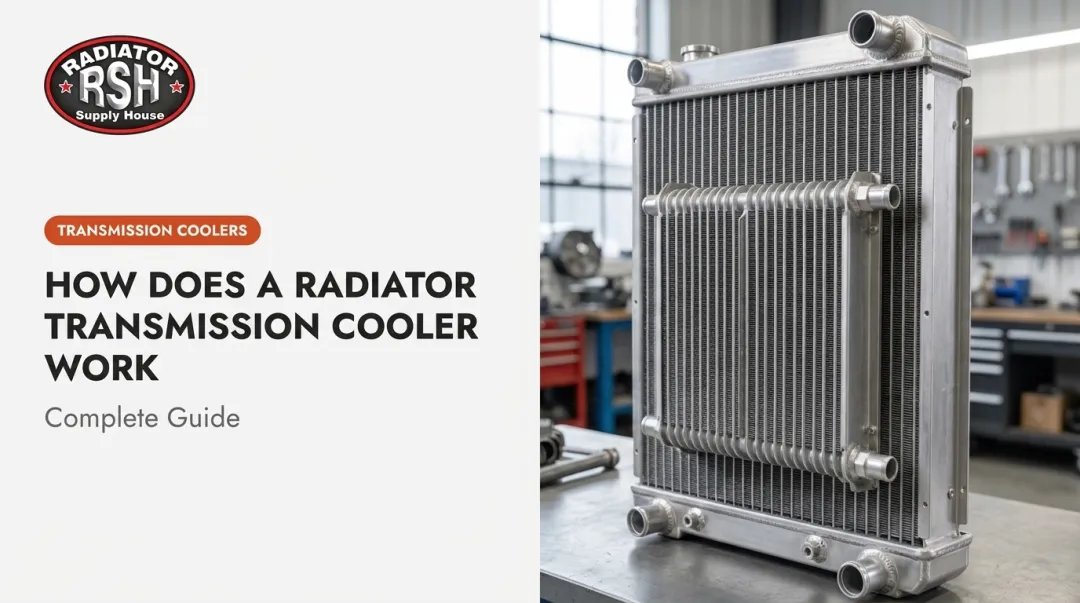
- Complete cooling packages (typically radiator paired with oil cooler) reduce the number of separate orders needed for a single repair
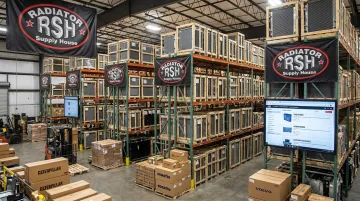
Working with one specialized supplier instead of piecing parts together from multiple vendors means fewer shipping delays and less guesswork on fitment. That translates directly into less downtime for the equipment sitting in your yard.
Frequently Asked Questions
What does a radiator condenser do?
There's no single "radiator condenser" part — they're two separate components. The condenser cools and condenses AC refrigerant from hot gas into liquid, while the radiator separately cools engine coolant.
How much does a radiator condenser cost?
Pricing varies widely by equipment type, exact fitment, and OEM vs. aftermarket choice. Heavy equipment and commercial truck parts typically cost more than passenger car components due to size and specialized construction.
Do radiators have condensers?
No. Radiators and condensers are separate components mounted near each other, not built into one unit. Some cooling packages combine multiple parts, but these typically pair a radiator with an oil cooler, not a condenser.
What are the symptoms of a bad radiator condenser?
Warning signs include warm air from AC vents despite the system running, visible refrigerant leaks or oily residue, and bent fins or dents from impact damage.
Can you drive with a bad AC condenser?
Yes, at least short-term: a failing condenser doesn't affect engine cooling. Cabin comfort will suffer, though, and unresolved refrigerant leaks can eventually damage the compressor.
How long do radiators and AC condensers typically last on heavy equipment?
Lifespan depends heavily on operating conditions, debris exposure, and maintenance habits rather than a fixed age. Regular inspection during routine servicing is the best way to catch problems early.