The stakes are real. Fleet operators are already fighting an uphill battle with unplanned downtime—TMC and FleetNet America's Q1 benchmark data shows truckload carriers averaging just 23,769 miles between unscheduled roadside breakdowns, even after an 8.8% quarter-over-quarter improvement. Overheating remains one of the most common triggers.
Here's the problem: most operators know their equipment has a cooling system, but few understand how it actually works stage by stage. That gap leads to undersized parts, reactive fixes, and failures that could've been prevented. This guide breaks down exactly how high-performance cooling systems operate, from the moment heat is generated to the moment cooled coolant flows back into the engine.
TL;DR
- High-performance cooling systems move more heat faster than standard OEM setups built for average duty cycles.
- The cycle runs in four stages: heat absorption, transfer/circulation, regulation, and dissipation/output.
- Core components include the radiator, water pump, thermostat, fans, and pressure cap, all matched to work together.
- These systems show up everywhere from racing engines to mining trucks, generators, and commercial fleets.
What Is a High-Performance Cooling System?
A high-performance cooling system is an engineered setup designed to remove heat at a rate that matches or exceeds what a high-load engine or machine produces. Standard OEM cooling is sized for average duty cycles. Push past that with towing, forced induction, high ambient heat, or continuous-duty operation, and stock components fall behind.
That's the gap high-performance cooling closes.
A bigger radiator alone won't fix the problem. Core size, coolant flow rate, airflow, and system pressure all have to work in balance. Oversize one component without matching the others, and you get cavitation, poor flow, or a system that still overheats despite looking beefier on paper.
Why Liquid Cooling Still Wins
Despite newer thermal technologies, liquid cooling remains the standard for combustion engines and heavy equipment. Cummins recommends factory-mounted radiators in liquid-cooled systems specifically because they deliver the lowest system cost alongside the best reliability and performance across duty cycles. That combination is hard to beat at scale.
Core Materials and Configurations
Not every high-performance system looks the same. The right build depends heavily on the application:
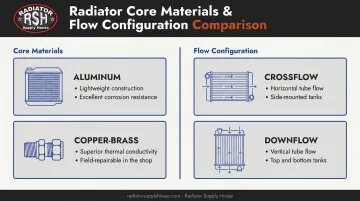
- Aluminum cores: lighter, corrosion-resistant, and tolerant of vibration; common in construction and mobile equipment
- Copper-brass cores: excellent thermal conductivity and easier field repair, though heavier and more prone to solder-joint fatigue
- Crossflow designs: side tanks with horizontal tubes, often used where width is available
- Downflow designs: top/bottom tanks with vertical tubes, suited to taller, narrower packaging
Wizard Cooling notes that cores with equal material, dimensions, and surface area cool the same regardless of orientation. The deciding factor is usually available packaging space, not one design being inherently superior.
How Does a High-Performance Cooling System Work?
The system runs on a continuous, repeating cycle. Four stages work together to keep temperatures inside a safe operating window, no matter how hard the machine is working.
Initiation: Heat Generation and Absorption
Heat starts building the moment combustion or mechanical friction begins. Coolant absorbs that heat as it moves through internal engine or machinery passages.
This stage is automatic. As soon as the engine or machine starts, a mechanical or electric pump gets coolant moving. There's no delay, no manual trigger.
The catch: this stage has a ceiling. Insufficient coolant volume, restricted lines, or an undersized pump can limit how much heat gets absorbed, regardless of how good the rest of the system is. This shows up often in retrofitted or upgraded heavy equipment, where a bigger engine or added load gets bolted onto a cooling circuit that was never resized to match.
Core Operation: Heat Transfer and Circulation
Once coolant has absorbed heat, it's pumped to the radiator core. Inside, it flows through tubes while air passes across surrounding fins, pulling heat out of the liquid and into the atmosphere.
Efficiency here comes down to two things: core surface area and tube design, not overall radiator size. A large radiator with poor tube geometry can underperform a smaller, better-engineered one.
Real-world numbers show how directly this scales with load. Cummins' CFPI59-F20 industrial engine data illustrates the relationship clearly: at 1,760 rpm, the CFPI59-F20-1 produces 171 bhp and rejects 3,442 BTU/min to coolant, while the lower-output CFPI59-F20-8 rejects 2,494 BTU/min at 90 bhp. More horsepower, more heat to shed—engineers size cooling capacity around that relationship, not guesswork.
Dual-pass and multi-pass core designs push this further by routing coolant through the core two or three times instead of once. That increases velocity and turbulence, improving heat transfer, though it also raises pressure loss, which is why pass count has to stay within the pump's limits. This principle shows up in racing radiators and heavy-duty industrial coolers alike.
Regulation and Control: Thermostat, Fans, and Pressure
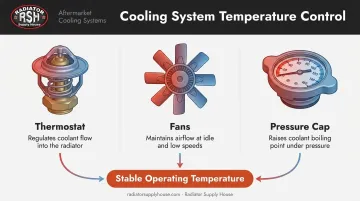
Three mechanisms keep the system from overshooting or undershooting its target temperature range:
- The thermostat regulates how much coolant flows into the radiator based on temperature, keeping the engine within its optimal range rather than running too cold or too hot.
- Fans, mechanical or electric, maintain airflow through the core, which matters most at low speeds or idle. This is a constant condition for loaders, generators, and other stationary machinery that doesn't get highway airflow to help.
- System pressure, controlled by the radiator cap, raises the coolant's boiling point. Higher pressure means the system can absorb more heat before coolant boils and loses its ability to transfer heat efficiently.
Monitoring tools round out this stage. Temperature gauges and sensors flag problems before they become catastrophic failures, a small investment that prevents costly downtime.
Output and Result: Cooled Coolant Returns to the System
Once heat has transferred out through the radiator, cooled coolant returns to the engine or machinery to repeat the absorption process. This closed loop is what supports consistent performance over long duty cycles.
Stable temperatures prevent:
- Power loss under sustained load
- Warping of engine components
- Gasket failure
- Coolant and fluid breakdown
Get this loop right, and the payoff is measurable: less downtime, longer component life, and sustained power output even during extended heavy-load operation.
Where High-Performance Cooling Systems Are Used
High-performance cooling isn't limited to one industry. It shows up anywhere heat outpaces what stock systems were built to handle:
- Racing and performance vehicles: sustained high RPM and forced induction
- Continuous-duty heavy equipment: construction, mining, and agricultural machinery running full shifts without cool-down time
- Commercial trucking and bus fleets: extended highway runs, towing, and turbocharged diesel engines
- Industrial power generation: generators operating at full load for days or weeks
What these applications share: sustained heavy loads, high ambient temperatures, turbocharged or supercharged engines, and duty cycles with little to no rest period.
Component requirements shift depending on the equipment and manufacturer, which is exactly why sourcing matters. A Caterpillar dozer radiator core, a Komatsu excavator oil cooler, and a Freightliner charge air cooler are built to different specs, with no universal part across brands.
A supplier with broad manufacturer coverage solves that problem. Radiator Supply House stocks cooling components across 300+ manufacturers, including Caterpillar, Komatsu, John Deere, Freightliner, and Volvo, plus ICEBOX Replacement parts engineered to OEM fitment and performance standards. Whether it's a single radiator core for a rebuild or a complete cooling package for a generator overhaul, matching the right component to the specific equipment is what keeps that equipment running instead of sitting in the shop.
Conclusion
High-performance cooling isn't one component doing all the heavy lifting. It's a continuous cycle: heat absorption, transfer, regulation, and output, repeating for as long as the engine runs. Weaken any single stage (an undersized pump, a mismatched core, a fan that can't keep up at idle), and the whole system underperforms.
Understanding that cycle changes how you approach maintenance and upgrades. Instead of reacting to an overheating warning, you can size radiators, pumps, and fans correctly before failure happens.
When it's time to replace or upgrade a component, working with a supplier like Radiator Supply House, one that understands the fitment differences across Caterpillar, Komatsu, Freightliner, and other major manufacturers, saves time and prevents costly mismatches.
Frequently Asked Questions
Which cooling system is best for high-performance applications?
It depends on the application—racing, heavy equipment, or industrial. The best setups combine a larger-surface-area radiator core, a properly matched water pump flow rate, and strong airflow management.
What is a highly efficient cooling system?
Efficiency means maximizing heat dissipation (BTU per minute) relative to core size, while minimizing flow restriction and parasitic power loss from fans or pumps. A bigger core isn't automatically more efficient.
What does a high-performance radiator do?
It dissipates more heat per minute than a standard radiator by using greater core surface area, improved tube design, and materials chosen for thermal conductivity, like aluminum or copper-brass.
What's the difference between a standard and a high-performance cooling system?
Standard systems are sized for average duty cycles. High-performance systems use larger core capacity, higher coolant flow, more capable fans, and higher pressure ratings built for sustained heavy loads.
How do I know if I need a cooling system upgrade?
Watch for rising operating temperatures under load, frequent thermal shutdowns, or noticeably reduced performance during extended heavy-duty operation. Treat these as early warning signs that call for immediate attention.
How often should high-performance cooling systems be maintained?
Schedule regular coolant flushes, inspect hoses and fittings for wear, and periodically check fans, pumps, and pressure caps. Catching small issues early prevents the expensive failures that come with neglected systems.