Introduction
Pull the drain valve on a compressed air tank after a humid shift, and you'll often see more water than air come out. That moisture doesn't come from nowhere. It's a byproduct of compression itself.
Air leaving a compressor's final stage is hot enough to soften seals, warp lines, and carry far more water vapor than cool air can hold. Left unchecked, that moisture ends up in your air tools, paint gun, or CNC spindle.
An aftercooler solves this. It sits between the compressor and the rest of your system, pulling heat out of the air before it can dump condensation downstream. This guide covers how aftercoolers work, the types available, how they differ from intercoolers and dryers, and how to size or replace one for your equipment.
Key Takeaways
- Aftercoolers cool compressed air immediately after compression, condensing moisture before it reaches tools, tanks, or lines
- Air-cooled units use fans for smaller systems, while water-cooled units handle higher-capacity industrial loads
- These units differ from intercoolers, which cool between stages, and dryers, which chase near-total moisture removal
- Skipping proper aftercooling invites corrosion, frozen lines, and premature seal failure
What Is an Air Compressor Aftercooler?
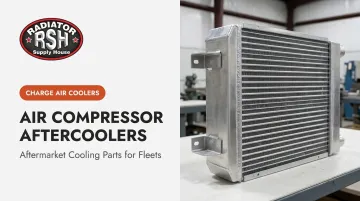
An aftercooler is a heat exchanger installed immediately after a compressor's final stage. Its job is simple: cool the hot discharge air enough to force water vapor to condense into liquid, so it can be drained before it travels any further into the system.
Compression generates serious heat. Manufacturer design specs for industrial aftercooler packages often use inlet air temperatures around 250°F as a baseline condition — a useful reference point for how much heat needs to come out before that air is usable.
The Typical Air Flow Path
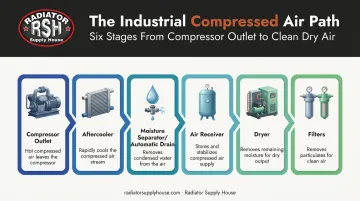
Most industrial systems follow this sequence:
Compressor outlet → Aftercooler → Moisture separator/automatic drain → Air receiver → Dryer → Filters
A few things worth knowing about where aftercoolers show up:
- Many rotary screw and industrial compressors ship with a built-in aftercooler as part of the package
- Reciprocating and older compressors frequently lack one and need an aftercooler added downstream
- A properly functioning aftercooler removes the large majority of the water vapor before air ever reaches the receiver tank, lightening the load on everything after it
- Reducing moisture at this stage extends the service life of downstream filters, dryers, and receiver tanks, cutting maintenance frequency across the whole system
Where Aftercoolers Matter for Heavy-Duty and Industrial Equipment
The same principle protects onboard air systems on trucks, buses, and heavy equipment, including air brakes, PTO-driven compressors, and pneumatic tools, all of which depend on cooled, drier air reaching critical components.
In truck air-brake systems specifically, the discharge line between the compressor and the air dryer is designed to cool the air/moisture mixture before it reaches the dryer. When that inlet temperature runs too hot, the dryer can't keep up.
In cold climates, this gets worse. Moisture that slips past the dryer can freeze in tanks and lines, increasing the risk of brake and valve malfunctions, according to Commercial Carrier Journal's cold-weather maintenance reporting.
How Air Compressor Aftercoolers Work
Compression squeezes air into a smaller volume, and that process generates heat fast as a straightforward consequence of physics. The problem is that hot air holds dramatically more moisture in vapor form than cool air does.
The "Rule of 20"
Here's the shorthand engineers use: every 20°F increase in air temperature roughly doubles its moisture-holding capacity, according to the Compressed Air and Gas Institute's Compressed Air and Gas Handbook. Run that in reverse, and every 20°F drop cuts moisture capacity roughly in half.
That's the entire principle an aftercooler exploits. Drop the temperature enough, and the air simply can't hold onto the water it absorbed during compression.
The Physical Cooling Process
Inside the unit, hot compressed air passes through tubes or finned surfaces while a separate cooling medium (ambient air or water) flows around or against it, pulling heat out.
| Cooling Type | Outlet Temperature |
|---|---|
| Air-cooled units | 15-30°F above ambient temperature |
| Water-cooled units | 5-15°F above the cooling water's temperature |
Lower outlet temperature means more moisture forced out as condensate, captured by a moisture separator and removed through an automatic drain. CAGI notes that operators should verify the outlet gauge stays within manufacturer limits, a common daily check on industrial aftercooler packages that sets the ceiling around 120°F.
What Happens Without Proper Aftercooling
Skip the aftercooler, or undersize one, and the consequences show up fast:
- Water accumulates in air lines, tanks, and tools
- Corrosion and scale build up inside piping and components
- Freezing risk increases in cold-weather operations
- Contamination hits sensitive applications like painting and precision machining
- Excess heat stresses gaskets, seals, and piping expansion joints
Types of Air Compressor Aftercoolers
Aftercoolers come in two main designs, and the right choice depends on flow rate, pressure, and how much plumbing you're willing to install.
Air-Cooled Aftercoolers (Aftercooler with Fan)
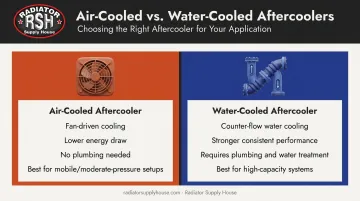
An air-cooled aftercooler (often called an "aftercooler with fan") uses an electric fan to push ambient air across finned tubes carrying the hot compressed air. The fan is typically wired to run in parallel with the compressor motor, so it kicks on whenever the compressor does.
Advantages:
- Lower energy draw than water-cooled systems
- Simpler installation, with no plumbing required
- Well-suited to mobile units and moderate-pressure setups
Water-Cooled Aftercoolers
Water-cooled units run cooling water in a counter-flow pattern, opposite the direction of the compressed air. This design pulls heat out more effectively and holds up better at higher capacities.
Trade-offs to weigh:
- Requires a dedicated water supply and plumbing
- Delivers stronger, more consistent cooling performance
- Adds installation complexity and ongoing maintenance (scale, fouling, water treatment)
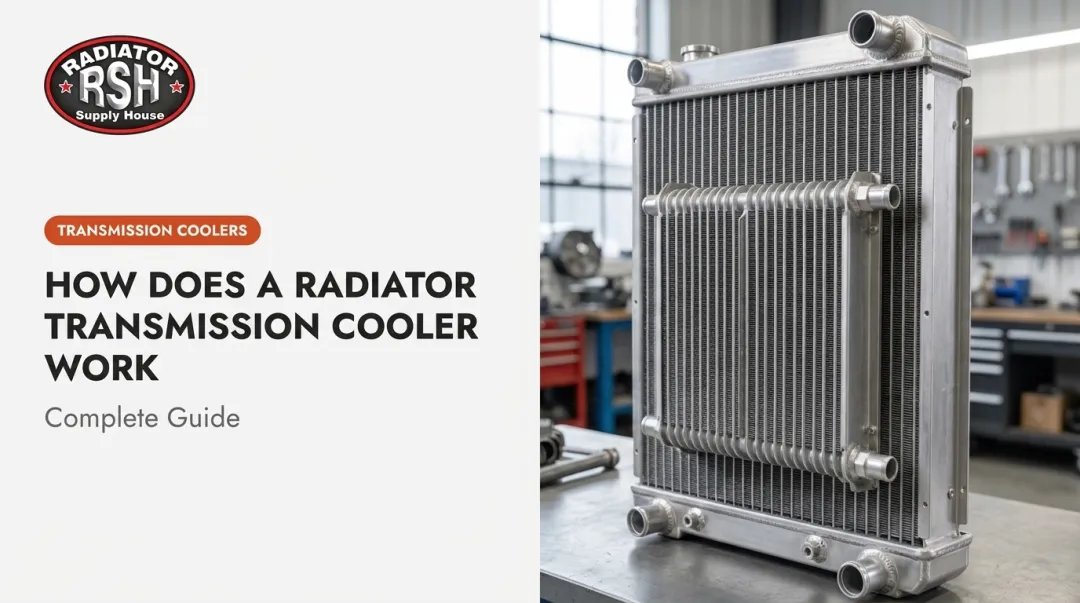
Some shop owners build a low-cost workaround for small compressors, repurposing a transmission oil cooler with an added fan as a makeshift aftercooler. It's not a substitute for an engineered unit on higher-flow systems, but it's a real option for a smaller shop compressor running on a tight budget.
Aftercooler vs Intercooler vs Dryer: What's the Difference?
These three components get lumped together constantly, but they solve different problems at different points in the system.
An intercooler sits between compression stages in multi-stage compressors, cooling air before it enters the next stage. Its main job is improving compression efficiency and reducing the workload on the following stage, not treating air quality for downstream use.
Atlas Copco frames it plainly: intercoolers cool air after the first stage, while aftercoolers cool it after the final stage, right before it leaves the compression unit.
| Feature | Intercooler | Aftercooler |
|---|---|---|
| Location | Between compression stages | After final compression stage |
| Main function | Improves compression efficiency | Protects downstream equipment |
| Temperature role | Reduces load heading into next stage | Cools air to final discharge condition |
| Moisture impact | Minor, incidental | Primary purpose — triggers condensation |
Single-stage compressors generally only need an aftercooler. Two-stage or multi-stage industrial systems commonly run both.
How an Aftercooler Differs From a Dryer
An aftercooler removes the bulk of the moisture, but it's not a dryer. Dryers chase much lower dew points for applications that can't tolerate any residual moisture — painting booths, instrumentation air, food-grade systems.
Dryers are typically sized around a specific inlet air temperature. Feed a dryer air that's already been cooled by an aftercooler, and it runs closer to its rated capacity instead of struggling against hot, moisture-loaded air.
In practice, that often means selecting a smaller, less expensive dryer than you'd need without upstream cooling. Just make sure sizing accounts for your dryer manufacturer's temperature correction factors.
Benefits, Sizing, and Maintenance
A properly sized aftercooler pays for itself in avoided downstream damage:
- Protects seals and lubrication from heat-related breakdown
- Reduces corrosion and freeze risk throughout the air system
- Extends the service life of tools, dryers, and receiver tanks
- Lowers the energy burden on dryers running smaller loads
Sizing Factors to Evaluate
- Compressor flow rate (CFM): the aftercooler must handle your system's full output
- Operating pressure: affects both cooling performance and material requirements
- Ambient temperature: air-cooled units lose effectiveness as ambient temps climb
- Application-specific air quality needs: painting and CNC work demand tighter moisture control than general shop air
Warning Signs an Aftercooler Core Needs Attention
- Reduced cooling performance or rising outlet temperatures
- Excessive condensate reaching the receiver tank
- Visible corrosion, fouling, or leaks in the core
- Non-operating fan or restricted airflow across fins
When an aftercooler core fails on heavy equipment, fleet, or industrial compressor systems, Radiator Supply House supplies replacement cores and complete assemblies across 300+ manufacturers, including Caterpillar, Komatsu, John Deere, Freightliner, Volvo, Cummins, and Ingersoll Rand.
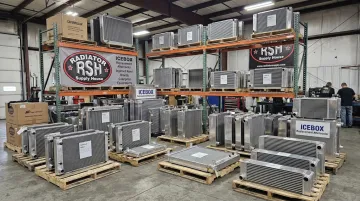
The ICEBOX Replacement line covers everything from standalone cores, like the Caterpillar AD45B aftercooler core, to complete OEM-equivalent assemblies for compressor systems such as the Ingersoll Rand 40/50 HP unit. Each is built in all-aluminum construction for durability and heat transfer performance.
Frequently Asked Questions
What does an air compressor aftercooler do?
It cools hot compressed air right after the final compression stage, causing water vapor to condense so it can be drained before reaching tools, tanks, or air lines.
What is the difference between an air compressor intercooler and an aftercooler?
An intercooler works between compression stages to improve efficiency and reduce load on the next stage. An aftercooler works after the final stage to cool air and remove moisture before it reaches your system.
What is an air compressor aftercooler with fan?
It's an air-cooled aftercooler design that uses an electric fan to push ambient air across finned tubing carrying the hot compressed air. The fan is typically wired to run alongside the compressor motor.
Do I still need a dryer if I have an aftercooler?
Yes. An aftercooler removes most moisture, but a dryer is still needed for applications requiring very low dew points. The dryer can often be smaller since the aftercooler has already done the heavy lifting.
How do I know if my aftercooler needs to be replaced?
Watch for reduced cooling performance, visible core corrosion or leaks, and excess moisture reaching downstream equipment. Rising discharge air temperatures are usually the first sign something's off.
Can I add an aftercooler to an existing air compressor?
Yes, it's a common upgrade. Shops typically plumb an add-on heat exchanger and fan between the compressor outlet and the receiver tank to retrofit older or reciprocating units that shipped without one.