Introduction
Order a "4 core radiator" and you might get the wrong part. It happens more than you'd think.
Heavy equipment operators, fleet managers, and repair shops throw around "core," "row," and "layer" like they're interchangeable. They're not. That mix-up leads to mismatched parts, delayed repairs, and equipment sitting idle longer than it should.
Here's the confusion in a nutshell: a radiator has one core. What people call "4 core" is actually one core with four rows of tubes stacked front to back.
Get the terminology wrong, and you risk ordering a part that doesn't match your mounting dimensions, flow rate, or cooling demand.
This guide breaks down the correct terms, explains how aluminum row construction actually works, and helps you match the right configuration to your machinery.
Key Takeaways
- "4 core" is slang; "4 row" is the correct term for core tube rows
- Fewer-row aluminum units often outperform higher-row copper radiators via wider tubes and shorter fins
- More rows boost cooling capacity, but heat rejection, fitment, and application matter equally
- Construction, ag, and trucking equipment typically need higher row counts than passenger vehicles
What Is a 4 Core Aluminum Radiator?
A radiator doesn't have four cores. It has one core built with four rows of tubes running front to back. The term "4 core" stuck around because most buyers never see how a radiator is actually assembled — they just repeat what a parts counter told them years ago.
Natrad's cooling guide defines the core as the section between the tanks, where tubes carry coolant and fins pull heat off those tubes into the passing air. Rows are simply the tube lines counted from the front face to the back face. A 3-row radiator has three tube lines, and a 4-row radiator has four: one core, multiple rows.
The Anatomy of a Radiator Core
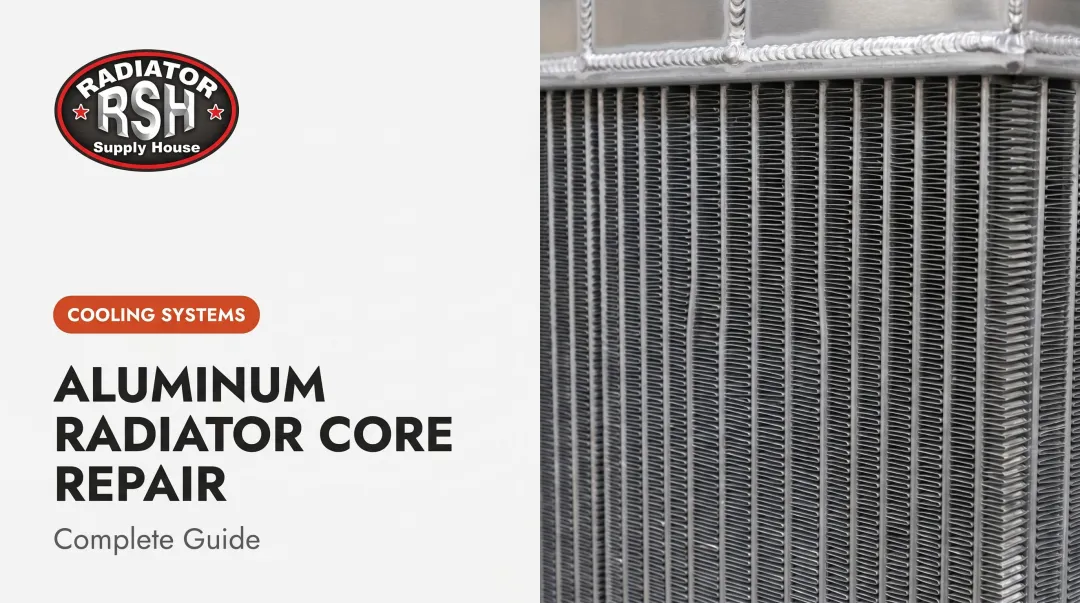
Every core, regardless of row count, is built from four brazed components:
- Tubes: carry hot coolant through the core
- Fins: thin metal strips that transfer heat from the tubes to airflow
- Headers: slotted plates that hold the tube ends in place
- Side plates: run perpendicular to the headers, giving the assembly structural rigidity
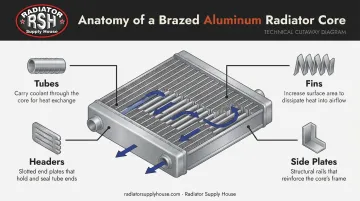
Stack more tube rows into that same header-and-side-plate frame, and you've got a "4 row" core instead of a 2 row.
Why the Terminology Gets Confused with Aluminum Designs
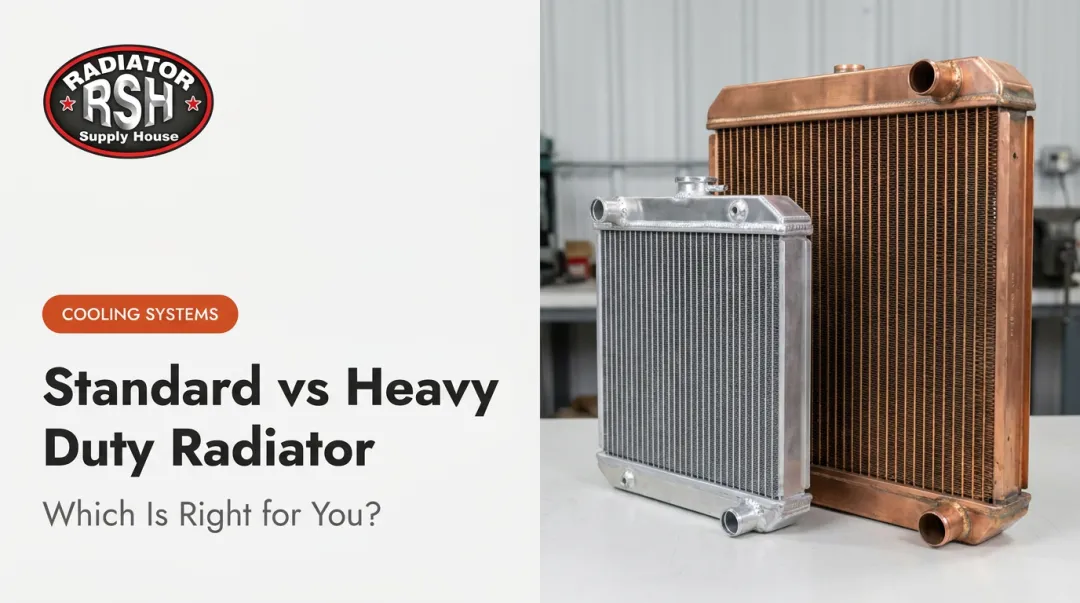
Aluminum construction is part of why the mix-up persists. Aluminum radiators use wider, furnace-brazed tubes and shorter fins compared to older copper-brass designs. That construction lets manufacturers fit more rows into the same physical footprint.
Buyers saw thicker aluminum cores with more visible tube layers and started calling each layer a "core." Some suppliers never corrected it. The habit stuck, even though it's technically inaccurate.
Radiator Supply House builds its aluminum cores to this same anatomy across 2, 3, and 4 row configurations, so the row count on the spec sheet always matches the physical tube count you receive.
How 4-Row Aluminum Radiators Work
Aluminum cores are 100% furnace-brazed. That eliminates the lead-solder layer found in older copper-brass units, which acted as an unwanted thermal insulator between tube and fin.
Wider aluminum tubes also increase the coolant-to-air contact surface. More contact area means better heat rejection per row than copper achieves at the same row count.
Row count alone doesn't tell you how well a radiator cools. A 2-row aluminum radiator can reject more heat than a 4-row copper radiator, depending on tube width and fin design.
A few other factors shape actual performance:
- Fins per inch (FPI): denser fin spacing improves heat transfer but restricts airflow and traps debris faster
- Fin type: louvered, serpentine, or straight fins each transfer heat differently
- Tube pitch: the spacing between tubes; tighter pitch means more surface area in the same core depth
- Tube surface design: dimpled tubes (used in several ICEBOX cores, including the Kenworth W900S 4-row core) increase turbulence inside the tube, improving heat transfer without adding rows
An SAE study on multi-row radiator design found that conventional multi-row cores leave air-direction gaps between rows for header ligament space. Those gaps lose thermal performance. Tighter tube-to-tube design closes that gap and improves conduction without needing an extra row.
2-Row vs 3-Row vs 4-Row: What's the Real Difference?
More rows generally mean more cooling capacity. Additional tubes carry more coolant, and greater surface area dissipates more heat. But there's a trade-off:
- More coolant volume: Each added row increases the coolant a core can carry
- Added weight: Extra tube layers make the core heavier and bulkier
- Reduced airflow per row: Air must push through more layers, cutting efficiency across the stack
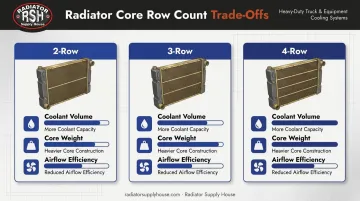
Here's how it typically breaks down by use case:
| Row Count | Typical Application | Notes |
|---|---|---|
| 1-2 row | Light-duty commercial trucks and utility equipment | Lower heat loads, intermittent use |
| 3 row | Light trucks, moderate towing, some off-road use | Balances weight and cooling capacity |
| 4+ row | Heavy trucks, construction, agricultural, mining equipment | Sustained high heat loads, continuous duty |
Fitment often decides the real answer. The available space in your equipment's frame or engine bay limits how many rows can physically fit, no matter what the "ideal" cooling calculation says. A 4-row core that doesn't clear your fan shroud or mounting brackets will need to go back, regardless of its cooling advantage.
Benefits of 4-Row Aluminum Radiators for Heavy-Duty Equipment
Construction, agricultural, and commercial trucking equipment run hot. Sustained load, high ambient temperatures, and long duty cycles push cooling systems harder than anything a passenger vehicle sees. That's where higher-row aluminum radiators earn their keep.
Why they hold up under pressure:
- Furnace-brazed joints eliminate the solder layer that weakens under vibration and thermal cycling — a real concern for mining, forestry, and material handling equipment running continuous shifts
- Wider tube surface rejects more heat per row than legacy copper-brass designs, without adding unnecessary bulk
- Matched OEM specs prevent downtime: running a radiator that's undersized for the engine's heat rejection rating is one of the fastest ways to trigger overheating shutdowns on a job site
This is where sourcing the correctly configured part matters more than most people realize. Radiator Supply House stocks ICEBOX replacement radiators, oil coolers, and charge air coolers across 300+ manufacturers, including Caterpillar, Komatsu, John Deere, Freightliner, and Volvo.
Configurations like the John Deere/Hitachi 4-row high-efficiency core (#870116) for excavator applications and the Kenworth W900S 4-row dimple tube core (#604775) show how row count, tube design, and OEM fitment come together for specific machines.
Some applications need more than a radiator alone. Radiator Supply House's Frac Kit series, built for Hyundai/Doosan gas and propane gensets, bundles a radiator with a matched charge air cooler in one combo unit. This combo setup is worth considering if your equipment runs an aftercooling circuit alongside the main coolant loop.
How to Choose the Right Core Configuration for Your Equipment
Getting the row count right isn't guesswork. It comes down to a handful of practical checks.
- Start with the engine's heat rejection rating: Cummins recommends sizing radiators with roughly 5% margin for engine production variation plus 10% for external fouling over time — a useful buffer to build into your selection rather than cutting it close.
- Factor in usage intensity: continuous heavy-load work like towing, mining, or agricultural operation demands higher row counts than light or intermittent use.
- Account for climate and environment: hot regions and dusty or humid conditions raise cooling demand and can call for additional rows or more core surface area.
- Check physical fitment first: measure frame and shroud clearance before assuming you can upgrade to a higher row count.
- Confirm the part number with a specialist: a quick call to a cooling supplier like Radiator Supply House can verify the right configuration for your specific make and model before you order.
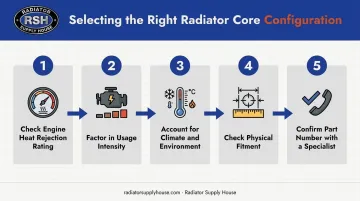
Skipping the fitment check is the most common mistake. A radiator with more rows and more cooling capacity is worthless if it doesn't bolt in.
Frequently Asked Questions
What does 4 core radiator mean?
"4 core" is a commonly misused term for what's technically a "4 row" radiator. It refers to four rows of tubes within a single core assembly, not four separate cores.
Is a 4 core radiator better than a 2-core or 3-core radiator?
More rows typically mean more cooling capacity, but material and tube design matter too. An aluminum radiator with fewer rows can outperform a copper unit with more rows.
How many cores can a radiator have?
A radiator typically has one core, though some units have two — for example, separate coolant and transmission cooling sections. "Number of cores" is often confused with "number of rows."
Is "4 core" the same as "4 row"?
Yes, in practice they refer to the same thing. "4 row" is the technically correct term; "4 core" is the common but inaccurate version.
Do heavy equipment radiators need more rows than standard truck radiators?
Often, yes. Heavy machinery runs at sustained, higher heat loads under continuous duty, so higher row counts or larger core surface area are frequently necessary compared to standard on-highway trucks.
Can I upgrade my equipment's radiator to a higher row count for better cooling?
It's possible if fitment and mounting allow it. Confirm compatibility with a cooling specialist before switching to a higher row configuration to avoid clearance or flow issues.