
Finding straight answers about this machine isn't always easy. Buyers, operators, and equipment researchers often hit a wall when searching for clear specs, capacity figures, real pricing, or confirmation that it's still in production.
This guide breaks down what the Cat 657 actually is, how it performs, where crews put it to work, and what it takes to keep its dual cooling systems running without unplanned downtime.
Key Takeaways
- Rated load of 46.4 tonnes (52 tons) — Cat's largest open-bowl scraper
- Heaped capacity reaches 33.6 m³ (44 yd³)
- Twin-engine design: Cat C18 tractor, Cat C15 scraper, boosts cycle speed and power
- Still in production, built for highway construction, mass excavation, mining, and reclamation work
- Dual engines double the cooling demand, making radiator and oil cooler upkeep essential
What Is the Caterpillar 657 Scraper?
A wheel tractor-scraper (WTS) does exactly what its name suggests: it cuts material from the ground, carries it in an open bowl, then spreads it somewhere else, all in one continuous cycle. No separate loader. No dump truck. Just cut, haul, and spread.
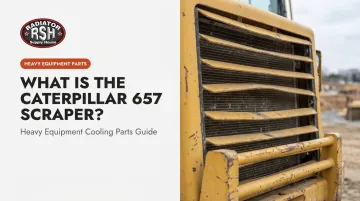
The Cat 657 sits at the top of that category. It's currently the largest open-bowl scraper Caterpillar manufactures, built for jobs where moving enormous volumes of earth quickly matters more than anything else.
Caterpillar continues to list the 657 on its active New Equipment lineup, meaning it remains in production and available through authorized dealers as of this writing. Availability can shift, so confirm current status on Caterpillar's official equipment pages before making a purchase decision.
A Machine Refined Over Generations
The 657 name has been around for decades, evolving through several generations (including the 657E and 657G) before reaching today's version. Each update brought incremental gains in fuel economy, comfort, and control.
The current generation launched worldwide in a December 2020 Caterpillar press release, skipping Japan and China. Caterpillar says this version delivers 7% better fuel efficiency than the outgoing 657G, along with a cab that's 21% roomier for long shifts.
The Twin-Engine Design Explained
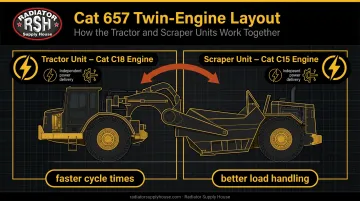
Most scrapers run on one engine. The 657 runs on two (one in the tractor unit, one in the scraper unit), operating independently but working in sync.
This "twin-power" configuration delivers:
- Faster cycle times, since each unit pulls its own weight instead of relying on a single powertrain
- Better load handling on grades and soft ground
- More consistent performance across the cut, haul, and dump phases
It's a deliberate trade-off: added mechanical complexity in exchange for real productivity gains on high-volume jobs.
Key Specifications and Capabilities
The 657's numbers explain why it's classified as ultra-class equipment. Here's the breakdown according to Caterpillar's product brochure:
| Specification | Tractor (Cat C18) | Scraper (Cat C15) |
|---|---|---|
| Net power | 436 kW / 585 hp | 333 kW / 447 hp |
| Emissions standard | Tier 4 Final / Stage V | Tier 4 Final / Stage V |
These high-output engines generate serious heat during sustained cutting and hauling cycles, so keeping the cooling system in good shape is critical to avoid overheating trouble in the field.
Capacity:
- Rated load: 46.4 tonnes (52 tons)
- Heaped capacity: roughly 33.6 m³ (44 yd³)
Performance:
- Maximum travel speed: 56.1 km/h (34.8 mph)
- Maximum cut depth: 440 mm (17.3 in)
- Maximum spread depth: 660 mm (26 in)
- Width of cut: 3.8 m (12.5 ft)
Caterpillar's live product page shows slightly different numbers for a few specs, including 47,174 kg rated load and a 417 mm cut depth. That's likely tied to configuration differences. Always verify exact specs for your unit's serial number before finalizing a purchase or fleet comparison.
Built-In Productivity Technology
The 657 packs several systems designed to squeeze more work out of every cycle:
- Payload Estimator – weighs the load on the go, with Caterpillar citing accuracy up to 95% of scale weight
- Auto-Stall – speeds up transmission warm-up during cold starts
- Ground Speed Control – operator sets a top speed while the system manages gear and engine combination to help cut fuel use
- APECS – coordinates engine and transmission for more efficient torque delivery
- Sequence Assist (optional) – automates repetitive machine commands, eliminating up to 14 inputs per cycle
What Does a Cat 657 Cost?
Caterpillar doesn't publish list prices for the 657. Its official product page directs buyers to "Request a Price" through an authorized dealer, since final cost depends on region, configuration, attachments, and delivery terms.
Expect new units to land in the high six-figure to seven-figure dollar range (USD), in line with other ultra-class earthmoving equipment. Treat that as a ballpark, not a quote — your local Cat dealer can give you an exact number.
How the Cat 657 Scraper Works
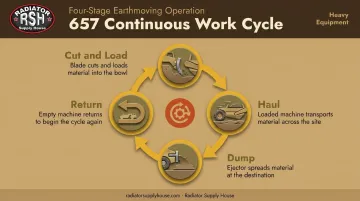
The 657 runs a continuous work cycle, repeating four stages on every pass:
- Cut and load – The apron lifts, the cutting edge bites into the ground, and material fills the bowl as the machine moves forward.
- Haul – Once loaded, the 657 travels to the dump site, using dual-engine power to hold speed even fully loaded.
- Dump – An ejector pushes material out of the bowl as the machine moves, so it spreads on the go instead of stopping.
- Return – The empty machine heads back to the cut area to start again.
Push-Pull and Fleet Operation
On tougher terrain, operators often run 657s in push-pull pairs — one machine helping push another during loading, then swapping roles. This spreads the workload and speeds up loading on ground that would otherwise stall a single scraper.
Fleets frequently run several 657s nose-to-tail on suitable haul routes, cycling continuously to keep material moving. It works best when haul distances and terrain line up well with the machine's strengths.
Comfort That Supports Long Shifts
Running these cycles for a full shift, whether solo or paired in push-pull, means long hours in the cab. The current 657 addresses that fatigue with three upgrades:
- A cab 21% larger than the previous 657G
- An air-suspension seat that adjusts and rotates 30 degrees
- Advanced Ride Management that automatically adjusts damping based on ground conditions
None of this changes how the machine cuts or hauls. But it matters when operators are logging 10- and 12-hour shifts, just as the dual-engine setup's constant load makes reliable cooling system performance essential to keeping the 657 running.
Applications: Where the Cat 657 Scraper Is Used
The 657's size and speed make sense in a narrow set of jobs: situations where massive earth volumes need to move fast.
Highway and road construction Long stretches of grading work benefit from the 657's speed and capacity, letting crews cut, haul, and spread across miles of roadbed without swapping equipment.
Mass excavation and site development Airports, dams, and large industrial sites often need enormous earth volumes moved on tight schedules. The 657's twin-engine output and 44-yard capacity help compress those timelines.
Mining and land reclamation Overburden removal and terrain reshaping are classic scraper tasks. Doing the cut-haul-spread cycle in one machine reduces how many pieces of equipment a reclamation job needs on site.
One historical reference point: Sukut Construction ran a fleet of 657G scrapers (the previous generation) on the Headlands Reserve development in Dana Point, California. That project required roughly 3 million cubic yards of earth moved, illustrating the scale these machines routinely handle. The current 657 builds on that same track record with greater engine output and hauling capacity.
Maintenance and Cooling System Care for the Cat 657
Running two high-output diesel engines means the 657 generates twice the heat load of a typical single-engine machine. That makes its cooling systems, including radiators, oil coolers, and charge air coolers, one of the most important things to stay on top of.
Caterpillar's own specs show why this matters:
- Tractor cooling system capacity: 88.6 L (23.4 gal)
- Scraper cooling system capacity: 63.2 L (16.7 gal)
- Coolant protection rated down to -37°C (-34°F) for cold-climate work
Skip a radiator inspection or ignore a slow oil cooler leak, and you risk an engine overheat that pulls the machine off the job entirely.
Practical Upkeep Tips
- Check coolant levels and radiator fins for debris daily, especially on dusty sites
- Run regular fluid analysis to catch contamination before it damages engine components
- Inspect oil coolers for leaks or reduced flow at scheduled service intervals
- Use the 657's ground-level access points for daily checks, with no climbing required for routine inspections
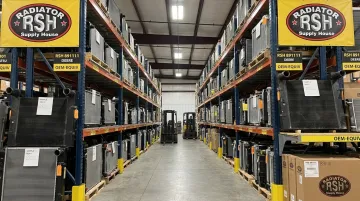
When a radiator, oil cooler, or charge air cooler does need replacing, sourcing the right part fast matters as much as the repair itself. Radiator Supply House stocks OEM-equivalent cooling components across 300+ equipment manufacturers, including Caterpillar, for machines ranging from construction scrapers to mining trucks.
For a machine as specialized as the 657, with separate cooling demands for its C18 tractor engine and C15 scraper engine, matching the right part to your exact serial number is critical. Their team can cross-reference OEM part numbers to help fleets find a compatible replacement and get back to work faster.
Frequently Asked Questions
How much does a Caterpillar 657 scraper cost?
Caterpillar doesn't publish public pricing for the 657. New units typically fall into a high six-figure to seven-figure range depending on configuration, but you'll need a local Cat dealer for an accurate quote.
How many tons does a Caterpillar 657 scraper hold?
The 657 has a rated load of 46.4 tonnes (52 tons) and a heaped capacity of about 44 cubic yards (33.6 m³), making it Caterpillar's highest-capacity open-bowl scraper.
What is the biggest Caterpillar scraper?
The Cat 657 is the largest open-bowl wheel tractor-scraper Caterpillar currently produces, outsizing every other model in its scraper lineup.
Does Caterpillar still make scrapers?
Yes. The 657 remains listed on Caterpillar's official New Equipment pagetoday, confirming active production through authorized dealers.
How much horsepower does the Cat 657 have?
The tractor's Cat C18 engine produces 585 hp (436 kW), while the scraper's Cat C15 engine adds another 447 hp (333 kW) — a combined output that sets it apart from single-engine scrapers.
What's different between the current Cat 657 and the older 657G model?
The current model, launched in December 2020, offers 7% better fuel efficiency, a 21% larger cab, and added technology like Payload Estimator and optional Sequence Assist.