Condenser replacement costs vary widely, typically landing between $1,500 and $5,000+, depending on unit size, efficiency rating, labor rates, and where you live. That's a big range, and the factors behind it matter more than most quotes explain.
This guide breaks down real pricing by tonnage, the variables that push costs up or down, when repair beats replacement, and how to size a new unit correctly before you spend a dime.
Key Takeaways
- National average condenser replacement runs about $2,900, with most homeowners paying $2,500–$5,000
- Unit tonnage and SEER rating are the two biggest price drivers
- Repair suits units under 10 years old; replacement wins for aging, failing systems
- Labor alone typically adds $300–$1,500 to your total project cost
How Much Does It Cost to Replace an AC Condenser? (Pricing Overview)
There's no flat rate for AC condenser replacement on trucks or heavy equipment. Cost scales with application, condenser capacity, and whether you buy OEM or an OEM-equivalent aftermarket part, so two units of similar size can carry very different price tags.
Aftermarket condensers typically run $200 to $800 per unit, while OEM-sourced parts often cost $600 to $2,000 or more depending on brand and availability. Complete replacement, including labor, generally lands between $500 and $2,800.
Cost by Application
| Application | Condenser Cost Range | Installed Cost Range |
|---|---|---|
| Class 8 on-highway trucks | $200 – $600 | $500 – $1,200 |
| Construction equipment | $300 – $900 | $700 – $1,800 |
| Agricultural machinery | $250 – $800 | $600 – $1,600 |
| Mining equipment | $500 – $1,500 | $1,000 – $2,800 |
| Power generation / gen-sets | $400 – $1,200 | $800 – $2,200 |
What's typically included in a standard replacement quote: the new condenser, standard installation labor, and a basic refrigerant charge.
What's usually excluded, unless you ask upfront:
- Mounting bracket or frame modifications
- Refrigerant system flush
- Additional hose or line replacement
- Diagnostic or leak-detection fees
Labor alone typically runs $100–$200 per hour for 2-4 hours of work, depending on equipment access and condenser location.
Three Rough Budget Tiers
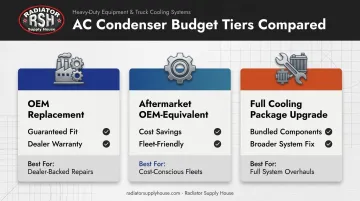
- OEM replacement – Guaranteed factory fit, dealer-backed warranty. Best when uptime risk outweighs cost savings.
- Aftermarket OEM-equivalent – Brands like ICEBOX match OEM specs at a lower price point. Best for fleets managing repair budgets across multiple units.
- Full cooling package upgrade – Bundles the condenser with related components. Best when a failed condenser signals broader wear across the cooling system.
Key Factors That Affect the Cost of AC Condenser Replacement
Technical specs, install complexity, and timing all stack together to set your final price. Here's what actually moves the needle.
Unit Size and Cooling Capacity
Cooling capacity is still measured in tons, with 1 ton equal to 12,000 BTUs, but equipment type drives that number more than square footage. A mining haul truck cab needs far more capacity than a compact skid steer, which means a bigger compressor, more refrigerant, and higher labor costs. A large dozer's condenser can cost multiple times more than a compact loader's.
Core Construction and Efficiency
Higher-efficiency condensers cost more upfront but reduce compressor strain and extend service life. All-aluminum cores run lighter and resist corrosion, while copper-brass cores handle heat rejection more efficiently in high-load mining and oilfield applications. That difference shows up in fuel consumption and wear over the machine's life, not just the price tag.
Brand, Warranty, and Refrigerant Type
Established brands with longer warranties cost more but reduce future repair risk. There's also a refrigerant shift underway across mobile equipment, with manufacturers moving from R-134a toward lower-GWP options like R-1234yf. This shift has occasionally strained parts availability, affecting pricing and lead times.
Labor, Accessibility, and Timing
Condensers buried in tight engine compartments, mounted behind grille assemblies, or requiring crane access on larger machines all add labor hours. A straightforward swap on a compact loader takes far less time than a job requiring extra rigging on an excavator or haul truck.
Timing matters too: summer is peak demand for cooling system repairs across construction, agriculture, and fleet operations. Parts pricing and rush labor fees climb when multiple machines need condenser work during the busiest stretch of the season.
Cost Breakdown and the Repair-vs-Replace Decision
Total cost isn't just the sticker price on a new condenser. It includes labor, any repairs you'd otherwise avoid, and the long-term value of a more reliable system.
Common Repair Costs
| Repair | Typical Cost Range |
|---|---|
| Capacitor | $100 – $450 |
| Contactor | $200 – $500 |
| Fan motor | $300 – $900 |
| Refrigerant leak repair | $400 – $1,500 |
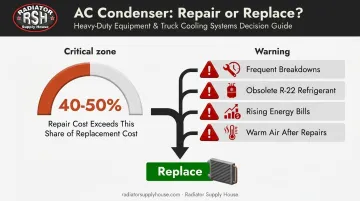
The general rule of thumb: if repair costs approach roughly 40-50% of a full replacement quote, replacement usually delivers better long-term value. Units over 8-10 years old paired with frequent breakdowns are strong candidates for replacement rather than another round of repairs.
Warning signs that point toward replacement instead of another repair:
- Frequent breakdowns, especially more than once a season
- Reliance on obsolete R-22 refrigerant
- Rising energy bills despite normal usage
- Warm air blowing even after recent repairs
Don't forget the line items that often get left off initial estimates: refrigerant recharge fees, electrical or pad upgrades, permit costs, and disposal fees for the old unit. Ask your contractor to itemize these before you sign anything.
How to Size the Right Condenser for Your Home
How to Size the Right Condenser for Your Equipment
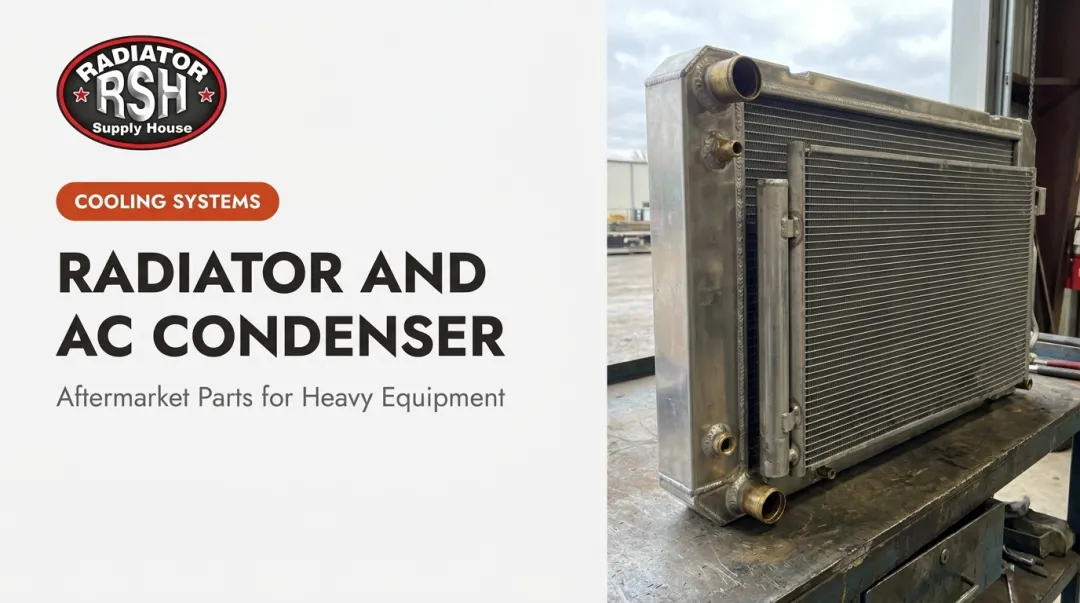
Matching an AC condenser to heavy equipment or a truck starts with OEM specifications, not a generic sizing formula. Unlike residential systems, these condensers are engineered for a specific engine bay, refrigerant charge, and airflow path.
Example: A Caterpillar excavator's condenser core handles cab cooling and hydraulic heat rejection together, so it can't simply be swapped for a same-capacity unit pulled from a different machine.
The safest approach is matching your existing condenser's specs — core dimensions, tube-fin configuration, and connection points — against a replacement or OEM-equivalent unit. This depends on:
- Cab size and cooling load requirements
- Engine compartment heat output and airflow design
- Operating environment, such as mining, construction, or on-highway use
- Mounting points and connection compatibility with existing lines
Getting the match wrong costs you twice. An incompatible condenser struggles to keep the cab cool and strains the compressor, while a poor physical fit can restrict airflow or damage surrounding components. Cross-referencing OEM part numbers remains the fastest way to avoid a costly mismatch.
Smart Budgeting Tips and Sourcing the Right Parts
A few habits can meaningfully lower your total spend without cutting corners on quality:
- Get at least three quotes and ask each contractor to itemize labor, equipment, and add-ons separately
- Keep up with maintenance: clean coils and filters extend condenser life and reduce breakdown risk
- Ask about rebates or financing through your utility company or the manufacturer
- Never mismatch a new outdoor unit with an old indoor coil — this reduces efficiency and can void your warranty entirely
These same principles around sizing, efficiency, and part compatibility don't stop at residential homes. Commercial trucks, buses, and heavy equipment cabs all rely on AC condensers too, and they fail the same way home units do, just with higher stakes when a fleet vehicle sits idle.
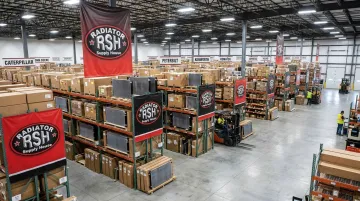
For fleet operators, repair shops, and heavy machinery owners, finding the right condenser fast matters as much as price. Radiator Supply House stocks OEM-equivalent AC condensers across a wide range of manufacturers, including Caterpillar, Komatsu, John Deere, Freightliner, and Volvo. This broad inventory means shops sourcing hard-to-find cooling components for commercial and off-road equipment can avoid the compatibility guesswork and downtime that come with the wrong part landing on the loading dock.
Frequently Asked Questions
How much is labor to install an AC condenser unit on heavy equipment or a commercial truck?
Labor typically runs $300–$1,500 total, or $100–$250 per hour, with most installs taking 3-6 hours. Costs run higher on machines with limited condenser access, like excavators or mining trucks.
Is it worth replacing the AC condenser on a truck or piece of equipment?
Usually, yes, if the unit is 10+ years old, leaks refrigerant repeatedly, shows corrosion damage, or repair costs approach half of a full replacement quote. Below that threshold, repair often makes more financial sense.
How do I know what size AC condenser I need for my truck or equipment?
Condenser sizing depends on your machine's make, model, and cab cooling requirements, not a general square-footage rule. Match part numbers against your OEM service manual or ask a parts specialist to confirm fitment.
How long does a heavy-duty AC condenser typically last?
Most heavy-duty condensers last 8-15 years, depending on maintenance habits, vibration exposure, and usage patterns. Dusty jobsites and off-road duty cycles tend to see shorter lifespans due to added strain.
Can I replace just the outdoor condenser without replacing the rest of the AC system?
Technically yes, but it's generally discouraged. Mismatched components reduce efficiency, create compatibility issues, and can void your new part's warranty.
Does a manufacturer or fleet warranty cover AC condenser replacement?
It depends entirely on your specific warranty terms. Most equipment warranties cover component failure but stop short of covering a full unit upgrade unless that's explicitly written into your plan.